Viltrox's L-Mount Debut – 16mm F1.8 (It Doesn't Disappoint!)
13 February 2026

There's a new player in the L-mount ecosystem, and it's not coming in quietly.
Viltrox has just released the 16mm f/1.8, and more importantly, it marks their first lens with full autofocus support for the L-mount system. It's also their first release since joining the L-Mount Alliance, which makes this a pretty significant moment for the system overall.
Price and Positioning: Competitive from the Start
Let's start with the numbers.
The Viltrox 16mm f/1.8 lands at:
£530 in the UK
Around $580 in the US
Around $599 in Europe (depending on taxes)
And that pricing immediately puts it in interesting territory. It's not "budget cheap," but it is clearly aimed at undercutting some of the established native options while still offering a fairly premium feature set.
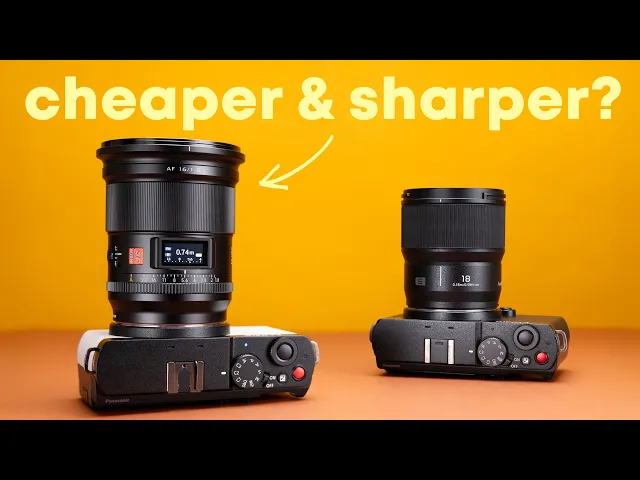
The closest native comparison is something like the Lumix S 18mm f/1.8. But even that comparison isn't straightforward because while they overlap in intent, they don't match perfectly in focal length, size, or handling.
Weight is one of the first differences you notice. The Viltrox comes in at around 550g, while the Lumix equivalent sits closer to 340g. That's a noticeable jump, and it hints at the different priorities each brand is working with: Viltrox leaning more into physical features, Lumix leaning into compact integration.
Build and Controls: A Feature-Rich Design
One thing becomes obvious immediately when handling the lens: this is not a minimalist design.
You get:
A physical aperture ring (clickable and de-clickable)
Two function buttons (though only one is fully supported on L-mount at the moment)
A small LCD display on the front showing focus distance and aperture
Close Focus and Wide-Angle Reality
One of the biggest practical differences between this lens and its Lumix counterpart shows up at close focusing distances.
The Lumix 18mm lets you get noticeably closer to your subject, which can be a big deal for tight interior shots or more immersive wide-angle compositions.
The Viltrox 16mm, by contrast, forces you to step back a bit sooner. Not dramatically so, but enough that you notice it when working in confined spaces.
There's also a bit more barrel distortion creeping in at the edges, particularly around straight lines like tables or architectural edges. It's not unusual for this focal length, and it can be corrected in post, but it's still something to be aware of.
Image Quality: Surprisingly Strong
This is where things start to get interesting.
In real-world use, the Viltrox delivers very strong sharpness and detail, even wide open. There's good control over vignetting for such a wide and fast lens, and the overall rendering feels clean and usable straight away.
At f/1.8, you also get:
Strong subject separation for a wide-angle lens
Pleasant transitions between in-focus and out-of-focus areas
Solid low-light performance
The background blur isn't "telephoto creamy," but for a 16mm lens, it does a better job than you might expect.
There's a sense that Viltrox has prioritised consistency across the frame, especially once you stop down slightly. And in many cases, that pays off.
Autofocus: Mostly Reliable, Occasionally Inconsistent
Autofocus performance is a bit more nuanced.
In good lighting, the lens performs very well: fast, responsive, and generally accurate. For most real-world shooting, it holds up without issue.
But there are a couple of caveats:
Occasional slightly soft frames appear in review
Performance drops a bit in low light
Some inconsistency shows up when reviewing files closely
It's not a deal-breaker, but it does remind you this is Viltrox's first real attempt in this specific L-mount autofocus space.
Overall, though, it's more like 95–99% solid than anything concerning.
Sharpness Comparison: Viltrox vs Lumix
A direct side-by-side comparison with the Lumix 18mm f/1.8 reveals an interesting split.
At a glance:
The Lumix tends to produce warmer, higher-contrast images straight out of camera.
The Viltrox often looks slightly cooler and more neutral.
In the centre of the frame, both lenses are surprisingly close in sharpness. It's at the edges where differences become more noticeable.
At wider apertures, the Viltrox actually holds edge detail better in some cases, while the Lumix starts to soften slightly toward the corners.
Stopping down (f/4 to f/8), both lenses perform strongly, but the Viltrox often edges ahead in corner consistency and fine detail retention.
The takeaway isn't that one is universally better; it's that they trade blows depending on where in the frame you're looking.
Video Performance: A Clear Winner for Native Glass
When it comes to video autofocus, the differences become more obvious.
The Lumix lens benefits from tighter system integration, including:
No visible focus breathing
More predictable transitions
Better compensation within camera processing
The Viltrox, while very usable, does show some focus breathing when shifting between near and far subjects. It also feels slightly less locked-in when compared directly.
For stills shooters, this won't matter much. For video shooters, it might.
The Missing Piece: Function Button Limitation
One small frustration is that only one of the two function buttons on the lens currently works properly on L-mount bodies.
It's unclear whether this is a firmware limitation or a pre-production quirk, but as of testing, FN1 is fully assignable while FN2 does not respond.
It's the kind of thing that could easily be fixed later, but for now, it slightly undermines the otherwise feature-rich design.
Why This Lens Matters for L-Mount
Beyond the specs, the bigger story here is what this lens represents.
The arrival of Viltrox into the L-mount ecosystem introduces something the system has needed for a while: more competition at lower price points, especially in the fast prime category.
That pressure tends to lead to:
Faster innovation
Better pricing
More focal length options
More experimentation in lens design
And that's where this becomes exciting. Because while the system already has strong native glass, there are still gaps, especially in affordable, fast, wide-angle primes.
Who This Lens Is For
The Viltrox 16mm f/1.8 makes the most sense for:
Budget-conscious L-mount shooters
Wide-angle photographers needing strong low-light capability
Hybrid shooters who value physical controls
People who don't mind a slightly heavier lens in exchange for features
It may not fully replace native options for everyone, especially video-focused users who rely on perfect autofocus behaviour and zero focus breathing.
But as a first entry into the system, it lands in a surprisingly strong position.
Final Thoughts
For a first autofocus lens in the L-mount ecosystem, this is a confident debut.
Viltrox hasn't just made something functional; they've made something that actively challenges established native options in both price and performance.
It's not flawless. Autofocus consistency and video performance still favour native glass in some situations. But in terms of sharpness, build quality, features, and overall value, it's a serious contender.
More importantly, it signals that L-mount is starting to get more interesting—not just for high-end optics, but for accessible, competitive third-party alternatives as well.